
1
Start from the car
The history belongs to one vehicle, even if you own more than one.
A service history is not a reminder. It is the story of what has already been done to this car: when, at which kilometers, and for what. RPMBase keeps that timeline with you, not only inside a shop's computer.
Free to start. The timeline lives on your phone. This website does not save a history.

 Coming soon
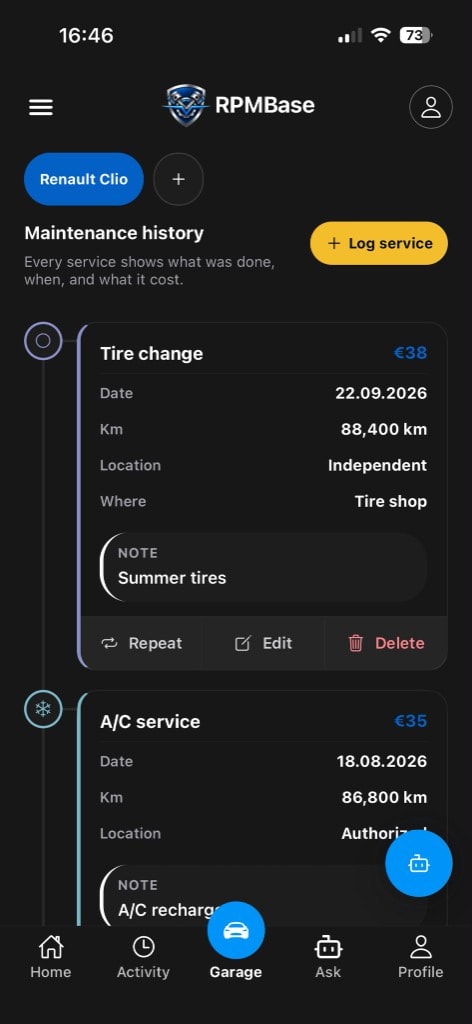
Each confirmed service is a row: the job, the date, the odometer, the cost, and a note if you need one.
If you bought the car used and a year is missing, leave it missing. An invented date is worse than a blank.
A photo can start the row. The image stays with the saved service so you can read the original later.
Fill-ups and insurance belong next to the history. The service timeline itself is the work that was done.
Two vehicles do not share a timeline. Switch cars to read the other record.
The dealer book still matters. This is the copy that travels with you when the workshop does not.
Enter the invoices that came with it. The empty years stay empty until you have a source.
A calm timeline is easier to show than a box of paper. You still keep the original invoices.
Either person can see the last brake job without calling the shop.
Ask when the timing belt was done, or whether the brake fluid was changed with the oil, and the answer is often a guess. The previous owner left a folder. Half the pages are missing. The shop that did the work may not be the shop you use now.
Buyers, family, and your future self all ask the same question: what has been done, and what has not? A pile of photos does not answer it in order.
Every confirmed service becomes a row on that car: the work, the date, the odometer, the cost, and a note if you need one. Fuel and other expenses stay beside it, but the service history is the work itself.
If you are reconstructing a used car, start with the invoices you have and leave gaps honest. An unknown date should stay unknown. RPMBase is a car service history app for the records you actually hold.
Memory is a poor service book because the expensive jobs are the ones you do not repeat every month. Timing belts, brake fluid, and coolant sit in the gaps. A timeline that names the kilometers is how you stop guessing.
A buyer choosing between two similar cars will pay more attention to documented work than to a verbal assurance that maintenance is up to date. You still keep the paper. RPMBase is the version you can show without emptying a folder on a table.
Building the record for the first time? Read how to keep a car service history, or, before you buy, how to check service history on a used car. The timeline itself lives in the phone garage, never on a public page.
What the timeline should hold, beside the stamped book.
Digital car service bookWhat a buyer can read, and what a PDF cannot prove.
Service records when sellingLog the visit and the next due point.
Car maintenance trackerTurn an invoice photo into a draft row you confirm.
Receipt scannerDescribe the visit in a sentence. Confirm the draft before it is saved.
AI garageNo. Keep the official book and the invoices. RPMBase is your copy of the history, written so you can read it without the shop.
Yes. Use the date and kilometers from the invoice. If the odometer reading is missing, leave it blank rather than guessing.
The tracker is the habit of logging work and what is due next. The service history is the record those logs become. They live on the same car.
The history belongs on the phone you already carry. Get App opens Download.
Coming soon